Or Ellie Finds Her Career Ikigai
Or If I Make People Mad with This One, Good
I would be streaming some Tomodachi Life: Living the Dream right about now if not for the fact that a recent Windows update I foolishly trusted messed up my machine. The brightness slider would not work, leaving my eyes to contend with godawful, eye-searing torture. Not only that, but my game testing in OBS ran at 5 fps. Then, just as I was about to roll back to a previous update, my screen suddenly went blank for a second, and everything when back to normal.
Despite this miracle, the ten minutes I spent trying to troubleshoot these issues left me incensed—and an incensed Ellie does not make good company. But I still feel like I have to do something mildly productive today. So here’s a blog post I started writing a few days ago. Maybe now the thrashing dragon within will settle down.
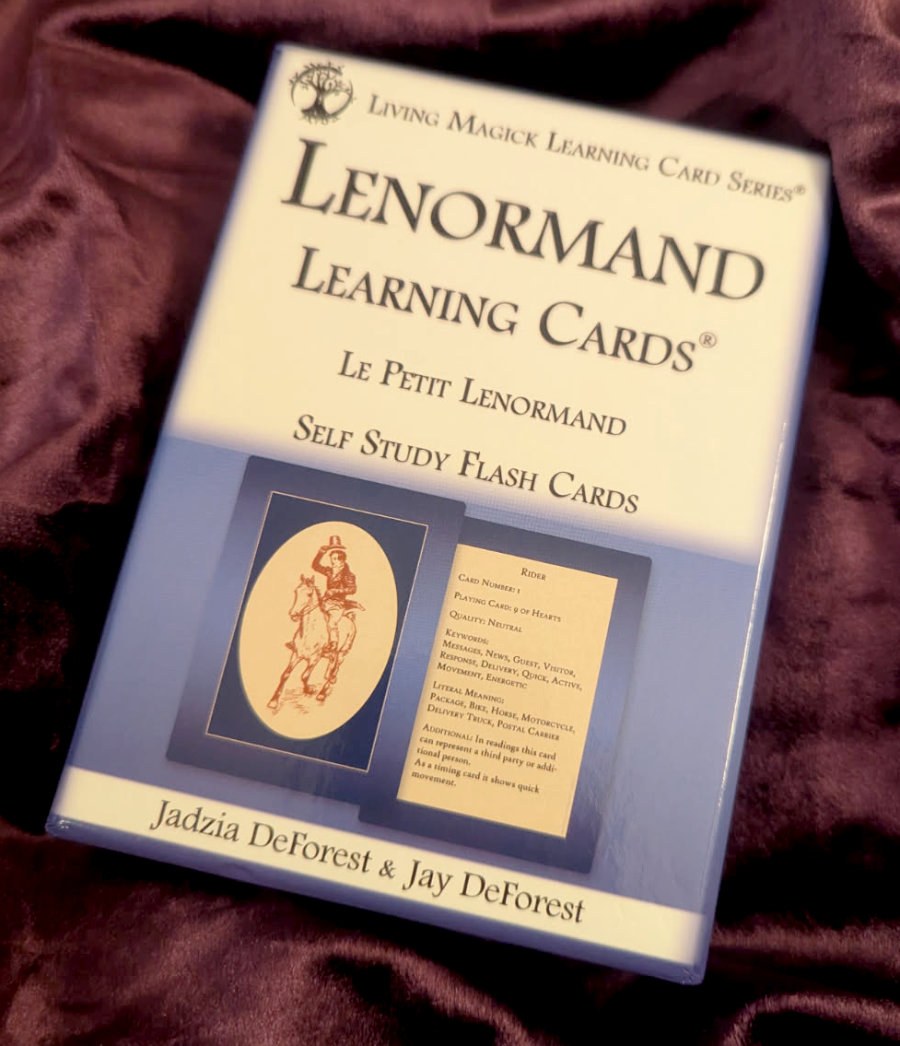
I’ve recently started working with the Lenormand system, and I gotta say, I think I like this a little more than tarot.
If you’ve been around for a while, you’ve seen my spreads: three main cards, then their clarifiers. And sometimes a whole series of these to explain different facets of an issue.
What can I say? I like to be as detailed as possible.
Other readers, I’ve noticed, interpret the cards separately, like structured categories. My style seems to be more like a conversation. Neither method is superior or incorrect, but I have noticed some differences between my style and what I see across the internet.
A lot of online readings—especially generalized ones—compartmentalize a spread. One card represents the issue, the next one an obstacle, the last one the outcome. Meaning comes from the positions, then the cards explain those positions.
Rather than isolating each card, I gravitated towards treating each card as part of a narrative. The clarifiers aren’t extra messages, either; they’re like extensions. Almost like a sentence with adjectives or clauses. I’ve come to learn that this is what some consider “symbolic syntax”. One card does something to another. This card changes the meaning. This card presents a pattern. The spread tells a short story.
That probably explains why the Lenormand felt familiar instead of strange.
The Lenormand is combination-based. No single card stands on its own. Pairs matter. A complete sentence is formed. Each card is intentionally barebones and incomplete, which is why you can’t draw a single one and conduct a 30-minute reading or a sensationalized YouTube short around it.
You drew the Snake. Deceit, transformation, lies? What the hell does it mean?
You drew the Clover next? Okay, luck, fortune, surprise, short-lived. We’re getting somewhere.
The Cross came up next? Burden, suffering, obstacle, guilt? Uh oh.
I’ve been told that if you go with an odd-numbered spread, the center card is the one to pay attention to. So with this one, it looks like something that appears lucky could be a hidden burden.
But if you read in pairs (Snake + Clover and Clover + Cross), the reading could take on a slightly different meaning. A bit of luck that arrives through something hidden, complicated, or transformative provides a brief reprieve from suffering.
Or why not combine them? After all, who’s to say this bit of hidden luck could alleviate suffering but also bring about a new kind of trouble?
It’s almost like solving the same math equation using PEMDAS or BODMAS. But this is where good, old-fashioned intuition and context come into play. (You’ll notice that I didn’t provide a query; that would have determined a single answer in that example.)By contrast, tarot cards are packed with symbology, from the corresponding astrological signs, to the presence of hats, to the colors in the sky and clothing. That’s why so many readers (myself included) get into the weeds in their sessions. They dive deep into the astrological aspects of each card. The Tower pops up and they spend several minutes unpacking someone’s impending “Tower moment”.
Lenormand perfectly scratches my narrative itch. In fact, I’ve found that if I start with it and follow up with tarot, my spreads are actually shorter. This is good. I’ve worried that my usual way or reading may end up confusing rather than helping.
I’ve also been told that my method is “recursive”, or revisiting cards in a single spread until I’ve figured out the context. This is probably due to the clarifiers I use; they can enhance or redirect meaning depending on surrounding combinations.
The Lenormand gets straight to the point. Symbolic chaining, sentence building, employing the instincts I already had. It’s nice when I find something that fits me.
Not that there’s anything wrong with my combination-based tarot, but there’s a bit more analyzing involved. That’s not quite how it’s usually done… *shifty-eyed* Although I have noticed an uptick in other readers and websites demonstrating how to read cards in combinations. Hm. Curious.
But I’m not choosing one over the other. In fact, I’ve found that both the Lenormand and tarot work very well together.
To illustrate, I’ll let you in on part of my professional development. As I’ve mentioned in a previous post, I’m getting things together for my dream profession. I’m staying way the hell away from the usual “I’m picking up on someone”/pick a pile/Spirit wanted me to tell you” bunk I see too much of on YouTube.
But I still had doubts. Despite all the readings I’ve done about this prospect, I wasn’t entirely sold on the concept that helping others through reading cards was my purpose/dream career/gift to the world.
So I turned to the concept of ikigai, or “one’s reason for being”. Then I gave it a cartomantic twist.
But first, let’s get some bullshit out of the way
Or this is where people blow their tops
I should point out that the ikigai diagram I’m referring to is a Venn diagram. You can do a search on it and find it for yourself, if you’re inclined. From what I’ve read about ikigai, the concept is closer to a feeling of meaning, fulfillment, and a reason for getting up in the morning. The Venn diagram is a Western concept.
And if you spend more than five minutes researching ikigai online, you’re going to find people arguing about this constantly. Because of course they would.
I’ve come across the famous diagram in blog posts, books, YouTube videos, and even Ikigai, Kaizen & Hansei by Makoto Saito. At the same time, you’ll also find Westerners like Nicholas Kemp criticizing other Westerners like Marc Wenn for using the diagram at all—while conveniently offering certification programs, coaching services, or personal branding courses of their own, natch
Fine. Have at it.
But I also don’t think it’s helpful to romanticize a country you claim to respect and admire into some kind of philosophical utopia where everyone discovers meaning through mindful daily rituals like drinking tea, sweeping the walkway, and watching leaves dance in the breeze. Karoshi still exists, after all. [1] [2]
What matters is that the diagram helped me visualize something that’s escaped me for years.
As someone who spent years feeling stuck, watching other people thrive in creative dream careers while I bounced between exhaustion and retail drudgery for most of my adult life, the framework gave me a way to visualize a future I could actually work toward. So many of these business types love to fluff up the idea of finding enjoyment in the little things, employing mindfulness, self-care, and other claptrap vomited repeatedly on social media platforms.
What they conveniently ignore is that it’s hard to find joy in small things when you’re exhausted—physically, emotionally, and mentally—and trying not to be disappointed about waking up every morning because of the soul-killing job you need to pay the bills. Believe me. There were days I could barely stand to pick up a pencil and make a simple sketch because the soul-deep tiredness of working inventory had poisoned me.
Not everyone is privileged to work in an office or begin a coaching/consulting business. Some of us need guidance, even if it’s hybridized. (Especially if it’s free.)
I also find it amusing when Western entrepreneurs champion themselves as gatekeepers of “authentic” ikigai while simultaneously building coaching brands, courses, and monetized content around it. Because they’re forgetting a very important aspect of humanity itself.
Cultures influence each other constantly. It’s just human. It’s going to happen no matter how many computer chair philosophers gripe about it. Japan itself has absorbed and adapted from Chinese philosophy, Korean culture, Western technology, European fashion, American media, and countless other sources throughout its history. Modern Western debates around “cultural appropriation” don’t always explain how every culture views exchange, adaptation, or influence. In addition, many Japanese people see other cultures incorporating aspects of their own as appreciation, not theft or insult.
Feels less to me like protecting a cultural concept and more like arguing over who gets to profit from interpreting it.
Back to the post
Or if that last section made you gnash your teeth, good—because being a provocateur is part of my ikigai
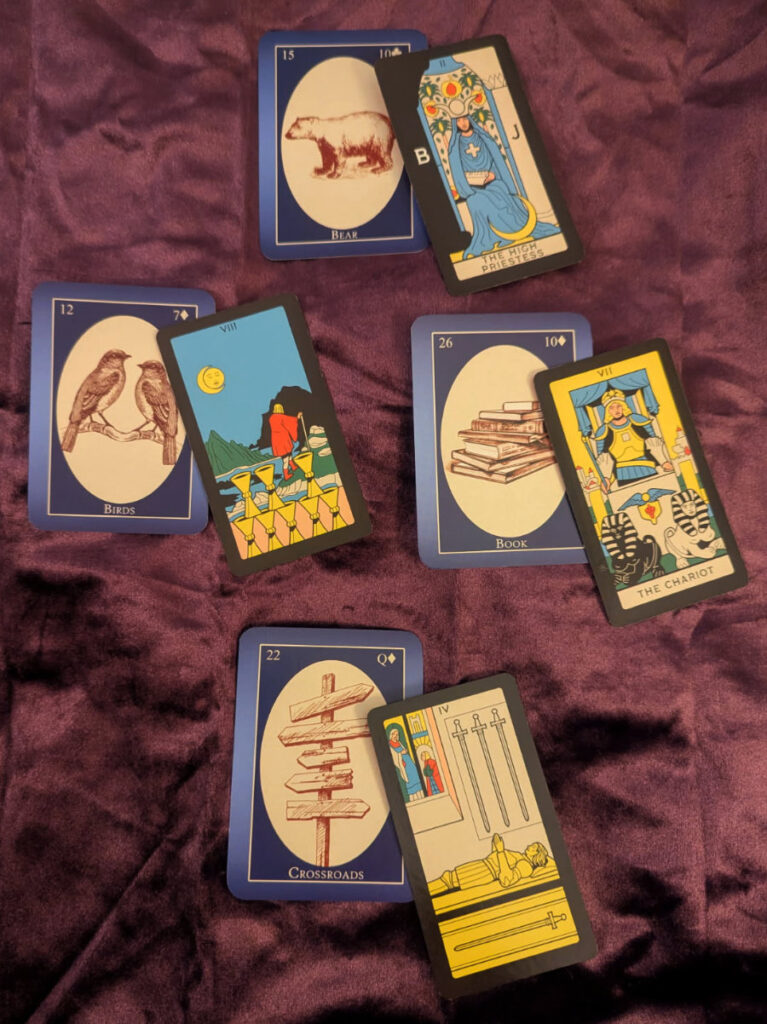
Now, using the (much loathed and delightfully polarizing) Wenn ikigai diagram as a card spread, I asked the same questions it presented.
I found that the Lenormand described the practical structure of my work while the tarot spread described the inner orientation and emotional meaning behind it. Neither contradicted the other. They complemented each other and described different layers of the same query.
The Lenormand handled the concrete realities, social dynamics, paths, and tangible circumstances, while tarot described my inner state, motives, and how I want to move through the world.
The Lenormand spread reads almost like an outline for a profession, something I’d get from one of those infernal online career quizzes. Except here, it’s useful.
What I love — Bear
Bear is strength, protection, stewardship, guidance, and sometimes authority. But here, this isn’t about power over others. It’s mama bear energy, protecting people while helping them navigate the world. It can also suggest helping others regain stability.
What I’m good at — Birds
Birds is conversation, interpretation, exchange, nervous energy, dialogue, and processing thoughts aloud. Maybe I talk too much. But that’s how I like to do my readings: interactive, reflective, layered, reflective, exploratory, narrative-driven. This card also represents discussion and connection, and even media and communication. Interesting, considering the plans I have to deliver this content.
What the world needs — Book
This one stood out to me. Book is knowledge, hidden information, learning, things not yet understood, and sometimes private matters. I’ve been helping people uncover what they don’t yet see. Given the education and training I’ve received as an MLIS candidate, this is especially poignant. I’ve been drawn towards archives, hidden structures, inaccessible information, and helping people reach such knowledge. This almost feels like a bridge between librarianship and cartomancy.
What I can be paid for — Crossroads
Crossroads is choices, decision-making, branching futures, uncertainty, and direction. People sometimes seek readers when they need direction or clues, and sometimes they’ll even pay for that insight. I’m not the type of reader who make promises or makes a spectacle of revealing “fates”. I believe life can be changed; if not drastically, then by incremental steps or small modifications that build up to make a difference. That’s why I’ve been helping people uncover options and study possible outcomes or consequences.
Then the tarot clarifiers go inward and reveal why.
What I love — The High Priestess
As much as I like mysticism and esoteric materials, I don’t really use tarot in this way. It’s more about uncovering what’s beneath a certain situation. The High Priestess is all about that, including observation, intuition, symbolism, and quiet understanding. She’s the intermediary between the physical and immaterial, conscious and unconscious, visible and invisible. For me, tarot isn’t always about learning what the spirits “want someone to know”, but rather uncovering what someone already knows or has yet to recognize.
What I’m good at — Eight of Cups
Eight of Cups is emotional transition, recognizing dissatisfaction, leaving behind what no longer fits, and searching for something more honest or fulfilling. I’ve been doing a lot of this work for myself. The rest of the world also sees this as a good thing to do, but some folks need a push or a clue about where to go or what to do. I also try to help others process emotions, progress, and direction, especially when they’re overwhelmed, burned out, or trying to make a change.
What the world needs — The Chariot
The Chariot is about movement, willpower, determination, and steering. This almost feels like a partner card to the Eight of Cups. People need direction or assistance with getting back on track. This card is also about agency, not fatalism.
What I can be paid for — Four of Swords
Four of Swords is rest, reflection, pause, processing, recovery, and mental quiet… exactly what the world needs more of. People these days are overstimulated, anxious, reactive, and trapped in loops. They need time and space to find what matters to them. Maybe a reading won’t give someone all the answers, but it gives them some room to think.
I’d say that I’m still on the right track.
It’s a nice, loose roadmap. It might change over time, and it probably should, considering I’m a growing human. But at least I have a starting point. That’s what matters.
And for anyone assuming I’ve turned ikigai into some kind of hyper-optimized productivity system: you’re getting that just from one post?
Stranger, you don’t know what I’m doing offline. You’re not going to know the entirety of my personality just because you read my personal blog. But since you’re nosy, I’m rediscovering smaller sources of joy outside of work and career anxiety. Things like drawing again. Reading more. Letting myself be curious about subjects without immediately asking whether they can be monetized.
Part of that curiosity led me into a deeper dive into Japanese culture and philosophy. I’ve been reading about Buddhism and Shinto, studying Japanese, and hoping that one day I’ll be able to read Japanese horror novels in their original language instead of through translation. (I’d love to know the joy and dread of an original Edogawa Ranpo story.) I’ve also been enjoying Kyota Ko’s YouTube channel, which has been a fun journey into both Japanese language and culture.
Maybe none of this leads to some grand revelation about my ultimate “true purpose.” Maybe that’s not the point. Right now, the point is that I’m moving again instead of standing still and watching others from the sidelines.
And I ain’t paying $190 to do it, either. Even with a $50 discount to use within the next two hours.