Something I’ve come to despise in fantasy is worldbuilding. Well, not the idea of it—the practice of it. The overabundance of it. The reams of text that surround a single concept because a writer took the “show don’t tell” rule seriously. In fact, maybe enlighten yourself and think critically for once about the “rules” you’ve been ordered to follow because some asshole author convinced everyone that they were an authority and should be obeyed without question.
Anyway.
Some of my favorite Patrick F. McManus pieces were when he explored a topic. Sometimes familiar friends and family popped in so he could further illustrate his point, but these were the times when McManus could freely opine and observe while twisting reality to fit his delightfully absurd worldview. He was the fool in many of his pieces, and he wanted you to know it, because he wanted you to be in on the joke. If he had an ego, it existed solely so it could be bruised.
This piece was written in that spirit. This isn’t a vignette or short adventure, just an observation piece. Because while I could write a 75K novel and try to smear the concept of ley line travel across those words… well, why should I? Why not have a character spend an afternoon writing about it? Why not have them completely overlook the fact that mages decided to build tea booths around a pervasive problem instead of improving some technology?
Just because it’s fantasy doesn’t mean it has to be written like a basic fantasy. I hope to find more writers experimenting with the genre. I remember encountering one writer who got so deep into worldbuilding, they decided to forego the usual “hero goes on a journey” story and write guidebooks about their creation. I hope they went through with it.
Here’s Brio rambling about ley lines. Maybe one day an editor will be allowed to touch his writing.
For the Plainrealm resident infected with wanderlust, the prospect of visiting another realm is very tempting. To enter Eximirene, one must be willing to hurtle through nothingness, ripping past the tendrils composing the fabric of time and space, and experiencing one’s very substance threatened with being pulverized into atoms.
Despite all that, this is still the preferred method of traveling between our two worlds.
“But, Brio,” says the hypothetical arguer, “it can’t be the only way!” And you’d be right. I’ve heard of so-called chosen ones hitching rides on Higher Spirits, and other talented magick users being able to open rifts between the realms and somehow not obliterate themselves in the process.
One ambitious soul attempted to fly a rocket ship into Eximirene. He died. Though judging by his insistence that his own world was flat, he may have done both realms a favor.
The newcomer to all this must be curious. First, I must explain what ley lines are. These are invisible streams of energy crisscrossing both Earth and Eximirene. These fantastic concentrations of earth or universal energy usually connect major landmarks, healing sites, sacred spots, and the occasional taco stand. Trust me, if you walk away having tasted the best taco you’ve ever had in your life, you will have found the presence of a ley line.
As it stands to reason, these ley lines meet in intersections. Every intersection on Earth correlates to one in Eximirene, though nobody can figure out how it’s happened. Cynics in Eximirene often say it’s a coincidence. I say otherwise. A coincidence lasting several millennia starts looking pretty deliberate to me.
Now we come to a brief history lesson about ley lines. Such as it is. How the first human found the first way to travel to and from Eximirene is still up for debate. Even the best time mages, some of the most powerful mages around, can’t pinpoint the exact moment. The answer has been lost somewhere in the scattered moments of human existence. But given today’s reactions to ley line travel, it can’t have been pleasant. But more on that later.
How this first person harnessed the powers is also up for debate. Early materials used in the first hubs are a good indicator. Quartz crystals along with some gold and flint were heavily used. I still find it incredible that the first traveler might simply have been lugging around quartz, gold, and flint when they accidentally stepped into a ley line and zipped into another dimension that would one day be called Eximirene.
A hub engineer could explain how it works better than I could, although I have to doubt their own knowledge. How three rocks and some mysterious mist manage to produce all this is beyond me. But I’m sure the explanation is fascinating and contains many scientific words. After my brief stint in law school, I’ve had my fill of sesquipedalian trifle.
The long and short of it is just as I don’t need to understand how a combustible engine works, I don’t need to know how ley line travel exactly operates. I just care that it works.
Now the hubs. It’s really a word for an intersection of ley lines. A hub can be anything: an obelisk, a bird bath, a tree. I once found a hub in an abandoned 1957 Chevy Bel Air. Getting to the control panel was a bit of a struggle, but once I bent my arm three different ways past thorny vines, I could zip all the way to the Wabash Hub in Chicago. I could get medical attention for my arm faster, too.
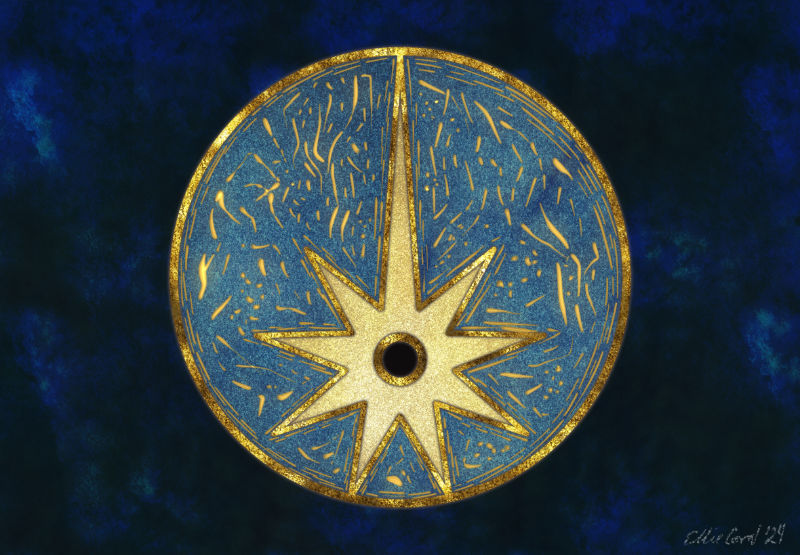
Once engineers have cleverly figured out how to harness the energies to make it usable (and relatively safe) for travelers, they design a control panel. This sounds high tech, but it’s really a misty interface that appears in thin air. Perfectly usable controls, complete with a spinning globe, lists of places, and a map of nearby intersecting lines. It’s accessed by a sigil painted with magickal ink somewhere on the hub. I recommend looking close to the ground to spot this nearly imperceptible, shiny symbol that looks like a vomiting bird on its back. Some people think it looks like a bunny sprouting a third ear. They clearly need their vision checked.
Once this sigil is spotted, tap it, and the control panel will manifest. Make your selection on the screen and brace yourself.
Now I must describe the indignities of ley line travel. The first time one experiences it, they will find themselves suddenly thrust into one direction, their muscles and internal organs rammed into each other. As everything is smeared against the inner lining of the skin, there is also the sensation of having one’s eyeballs extend a few inches outside of the sockets and the hair being whipped around as if a giant Hollywood fan has materialized. Clothes feel like they’re becoming one with the outer skin. Close to the end of the journey, one may feel that they’re being spaghettified and are moments away from rejoining the source of the universe.
Then, it’s all over. Close to it, anyway. At this point, the traveler has shot out of the ley line, but now they have another problem: landing safely. Although travel is done horizontally, there is no danger of falling from lethal heights. The problem here is momentum and finding a safe place to stop—or crash.
If you were smart on your first trip, you’ll be going through a well maintained hub station. These will have several portals, each with a comfy landing pad of sorts. These terminals each consist of a pleasantly cushioned running lane, ending in a bumper that may catch the traveler or bounce them harmlessly onto the padding. Either way, the traveler will have somewhere soft to go… ideally.
As for terminals where such bumpers don’t exist… well, it helps if you can “run into the flight”, so to speak. Get your legs pumping and prepare to literally hit the ground running. Yes, even while you’re hurtling. Upon exiting the line, you might be able to jump into a stop or slow yourself down. Or simply run all the way to town with your borrowed horsepower.
Beginning travelers will often suffer from intense motion sickness, muscle fatigue, dry mouth, headache or migraine, eye strain, runny nose, intestinal distress, itchy teeth, clumped eyelashes, and malaise. A proper hub station will have booths where travelers can recuperate with traveler’s tea or a solid nap. Traveler’s tea is made from a lovely herb grown exclusively and abundantly in Eximirene, and sells for grotesque amounts of money in the Plainrealm.
Recovery time can take anywhere from half an hour to three days. Although there have been serious cases where travelers spent those three days sleeping in a booth, they’re few and far between. I’ll admit to faking a few ailments just to have a roof to sleep under, especially when I’m in areas where the inns have been known to host more vermin than humans. It helps to wear different clothes or a few bruises to avoid recognition. I find that a swollen bottom lip or a black eye also does the trick.
Can anyone just hop into a ley line and coast down to another town? In some cases, yes, especially in the cases of rogue hubs. These are your abandoned units, though there are “experimental” ones that aim for faster travel. Always fun, especially with inebriated companions.
Some bigger cities have taken the Earthling concept of a metro card and created ley-keys. Each one is enchanted with a specific person’s identity—hell if I know how they figured that out—to make travel more efficient. Folks are desperately hoping this idea never reaches the wider masses in Eximirene.
But the higher classes are certainly making use of it—and despite not being of high class, I still benefit. Being contracted by a noblewoman and entrusted with doing some very important work, I get a dandy ley-key that I can use to access any line. It has the added bonus of mitigating the effects of travel.
These cost a pretty penny—or a modestly attractive Eximirean floreal—but it didn’t come out of my own pockets, which is always an added bonus. These are made of an alloy from quartz, gold, and flint, and a few other minerals to prevent it from shocking the user when harnessing ley lines. (Did I mention the mild electrocution in some cases?)
Those are the basics of ley lines, their travel, and related ill effects. Don’t be afraid. Fire up a hub and jump on the inter-dimension highway. But maybe learn how to run while flying. It might shave off up to an hour of walking time.
This may never make it into an Eximirene story, but I thought it was worth including. After reading this piece, my friend James had an idea of who the first ley line traveler might have been. If they were carrying a combination of quartz, gold, and flint all at once, they were very likely a miner.
I didn’t even think about what this figure looked like or what they did for a living. Until that moment, they were just an amorphous figure created only to fill out part of Brio’s writing. Because of my friend’s supposition, that unknown figure suddenly became more real… and maybe even a little more human.