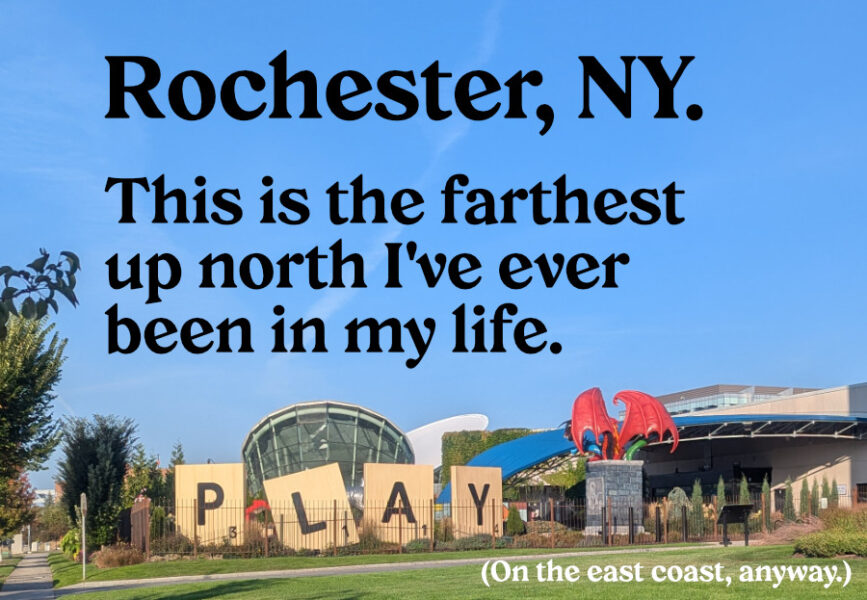
I could go into excruciating detail about my first conference trip, but most of it’s pretty academic and therefore sand-blastingly dry—trust me, you don’t want the blow by blow—but Board Game Academics was possibly the best first conference I ever could have had. Considering I was the only librarian/information type person among 75 people, I felt that I represented my future field very well and left no awkward impressions.
I’m sure conventions are more exciting since they offer variety and adventure, as well as the chance to stalk harass seduce meet your favorite celebrities and online creators. While there was nothing star-studded about BGA, I can imagine a handful of convention folks going “OOOHHHHH” if they saw this person:
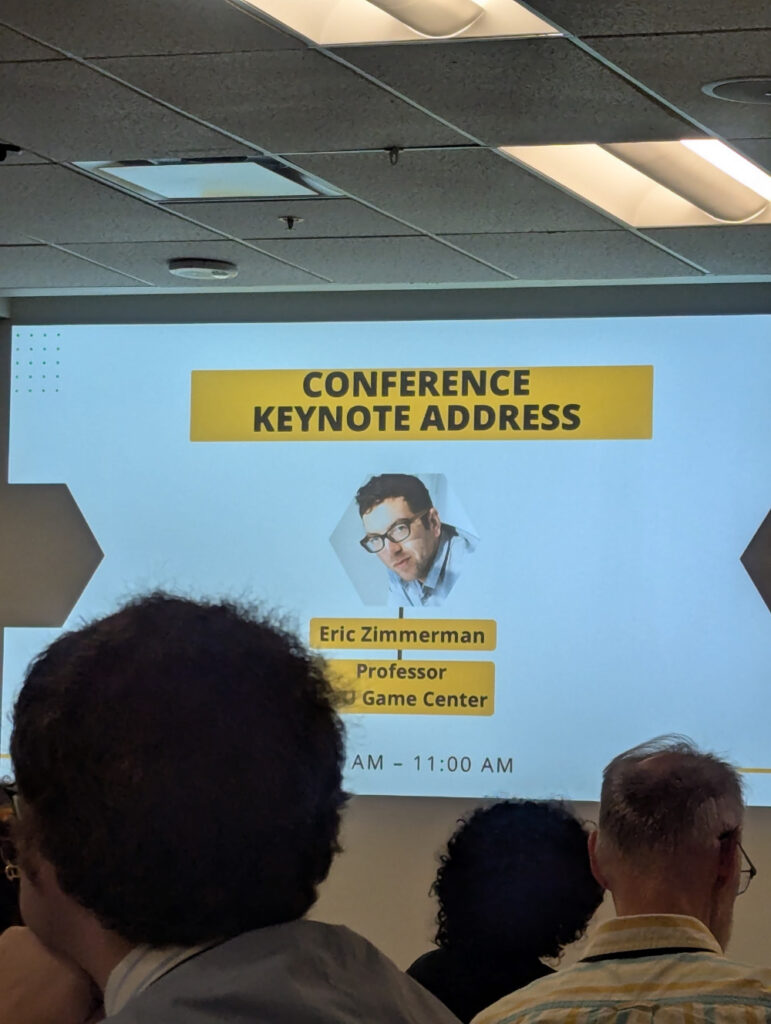
To the online world, Eric Zimmerman is the co-creator of Diner Dash and cofounder the now-defunct Gamelab. To everyone at the conference, he was the keynote speaker, a prominent voice in game design theory, a professor at NYU’s Tisch School of the Arts, and a major part of the New York Game Center. The man keeps busy. He received a respectful round of applause as he took the podium, and then proceeded to give probably the best presentation the entire conference would see. (No offense to the other presenters. I mean it when I say that there was something for everyone. But if BGA is going to successfully carry out its mission to take this out of the ivory tower, we need to de-emphasize the “academic” part, just a smidge. Get?)
I’ll keep it brief, but Zimmerman talked about his training as an artist, how he’s not a programmer and does mostly TTGs, and his books. The Rules We Break looks especially interesting; we even got a taste of playtesting with Utopia 2099 from it. Just from this single presentation, I can definitely see him as a professor, and probably a beloved one at that. If he doesn’t have tenure yet, give it to him, Tisch. Universities would kill to have this kind of talent.
(If you’re wondering—and you’re probably not—yes, I did take notes through the presentations. But they’re like the notes I take for my courses: boring, scattered, and barely legible to other humans. So you won’t see them.)
Another way this conference was the best first one was the dress code. I was always under the impression that conferences were business casual, and I did bring along such clothes. But here I saw a mix of silk ties and suits, polo and button-up shirts, dresses, t-shirts (one teacher wore a PAX shirt and gym shorts), and jeans. So many jeans. Even Zimmerman was dressed like he’d walked in from the street but decided to class it up a bit with a blazer. One of the presenters was proudly wearing a traditional kilt. If I attend their Tabletop Scholars conference next year, I’m wearing my Chucks and a lived-in tee.
Yet another way this conference was the best first one was the extras. Since this was held at The Strong National Museum of Play, the organizers arranged time for tours of the museum and archives.














I took more photos than what I’m showing here, but I’m not the best photographer, and I don’t really feel like uploading every single photo I took. As for the archives, I’m not sure how much I can legally show. Still, I can share one story… I think… and why wouldn’t The Strong appreciate some free advertisement? By this point, it might have already made the rounds in other people’s circles. (Besides, this is a small blog. How much trouble could I cause?)
The Strong’s archives is a sprawling arrangement of Spacesaver shelves containing all manner of games, dolls, costumes, trinkets, and whatever you can imagine. If it’s connected to play in some way, they probably have at least one copy of it. Included in its storage is a “copy” of the stand that once held up the original Wheel of Fortune. Just the wooden stand, not the spinning wheel.
Even then, I could feel the quiet reverence settling over the crowd. We’d been eager to go down other aisles to gawk at the items, but the docent had to coax us down this space. But no touching and no photos. The stand almost looked unimpressive: wavy gold decals still clinging to the wood after all these years, ancient wiring with faded insulation, an age-blurred IATSE logo stamped on the particleboard, and the conjoined, rounded podiums painted in bright primary colors.
But here’s where the story becomes interesting. The stand was in two pieces. It had to be cut in half so it could fit through an entryway. That’s nothing compared to what The Strong will have to do to accommodate the puzzle board. Because of its sheer size and unique shape, this piece will require a custom transport just to get it across the country. When it finally arrives, the museum staff will have to tear down a wall to move the thing inside. If there’s a documentary about this, I’m watching it. I’ll subscribe a month to whatever overpriced streaming service has the rights to play it.
After the archives tour, we headed back to the presentation room for some playtesting. There was Alazar: The Collaborative Worldbuilding and Storytelling Card Game by Trent Hergenrader, and 200 Year Old Vampires: Reflecting on Motion Picture History by Christopher Jeansonne. I won’t share too much of the former in case anything is still under wraps, but the concept wowed me so much that I immediately started thinking about my own storytelling card game.
Jeansonne’s game made an equally big impression on me. If you’re unfamiliar with solo journaling games, one of the best-known examples is Thousand Year Old Vampire by Tim Hutchings. It inspired a spiritual successor, 500 Year Old Vampire, which explores art history (the creator’s name escapes me, though they’re a colleague of Jeansonne’s). Jeansonne’s own version dives into film history. Three creators, three different stretches of time, all building respectfully on each other’s ideas, with mutual permission and encouragement. No claim to strict copyright, no attempts to take down another creator. It felt cozy.
Quite a stark contrast to the current state of the video game industry, where big names often seem eager to crush anyone with a “too-similar” concept.
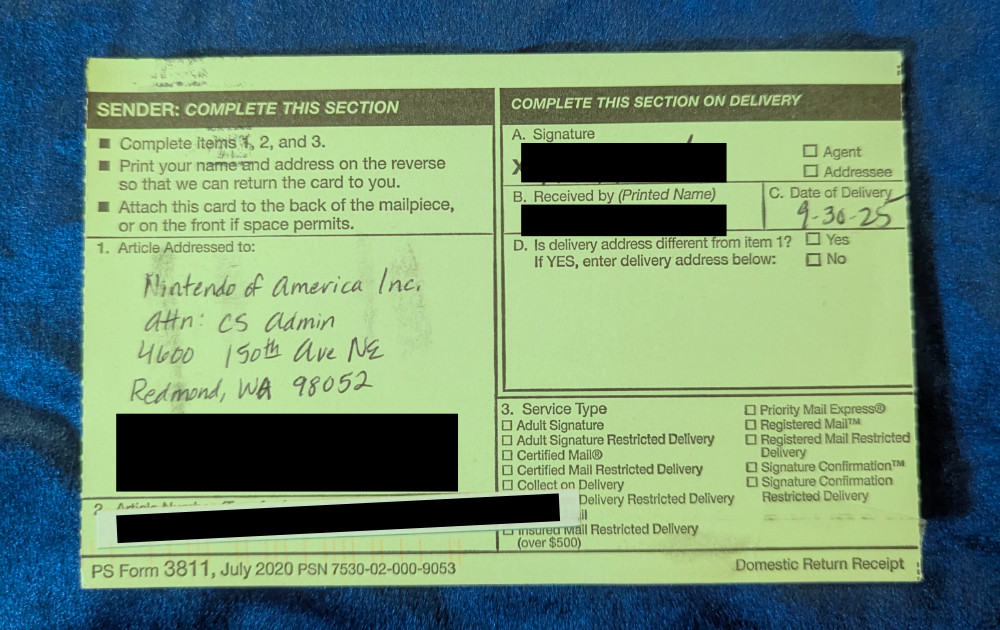
Speaking of, this was the first thing I did when I got my Switch 2: pay $11 to mail out a formal letter asking to opt out of Nintendo’s arbitration quagmire. Forbid I ever have a legal issue with Nintendo, I can actually go to court.
Seeing that piece of mail made me think about how litigious the video game industry is currently, and how seemingly (key word) open the tabletop game world is. So, remembering Hergenrader and Jeansonne, I got to work on this:
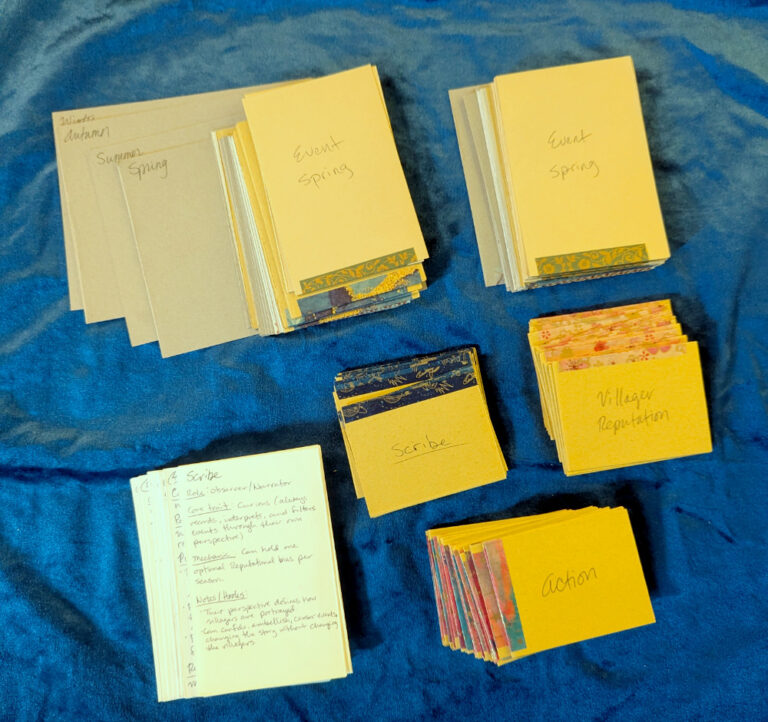
All of which is a roundabout way of saying that I’m planning to attend Unpub at PAX East 2026.